
When you pick up a plastic bottle, glance at a car part, or open a food container, there’s a good chance you’re touching something made of thermoplastic. This special kind of plastic is everywhere in modern life. In simple terms, a thermoplastic is a material that softens when heated and hardens again when cooled. This ability to reshape and recycle makes it a cornerstone of modern manufacturing.
In today’s industries, thermoplastics matter because they help create lighter, cheaper, and more efficient products. They support innovation by enabling complex shapes, smart designs, and new material blends. From reducing waste to improving product performance, thermoplastics are playing a growing role in sustainable design. In this article, we’ll walk through what thermoplastic means, how it’s made, its main types, its strengths and limitations, real-world uses, and what the future might hold.
Understanding Thermoplastic
In the simplest terms, thermoplastic is a kind of plastic that can be softened with heat and then hardened again when cooled. The key feature is that this process—heating, shaping, cooling—can often be repeated many times without permanently changing the material’s chemistry.
Why is this useful? Because it gives manufacturers flexibility. If a part is imperfect, it can be re-melted and reshaped. And because thermoplastics respond predictably to heat, they let designers and engineers produce very precise shapes and features.
Thermoplastics differ from another broad class called thermosets. Thermosetting plastics change through a chemical reaction (curing) and become permanently rigid; after they set, they cannot be melted again. In contrast, thermoplastics remain reversible under heat (until damaged).
Also, thermoplastics may have different internal structures—some are more ordered (semi-crystalline) and some more random (amorphous). That affects how they behave under stress or heat.
How Thermoplastics Are Made?
Understanding how thermoplastics are produced helps illustrate their versatility.
At the start, raw materials—usually small units called monomers—are chemically linked to form long chains called polymers. These polymer chains form the backbone of the thermoplastic. Sometimes additives (fillers, stabilizers, colorants, etc.) are mixed in to improve strength, resistance to light or heat, or appearance.
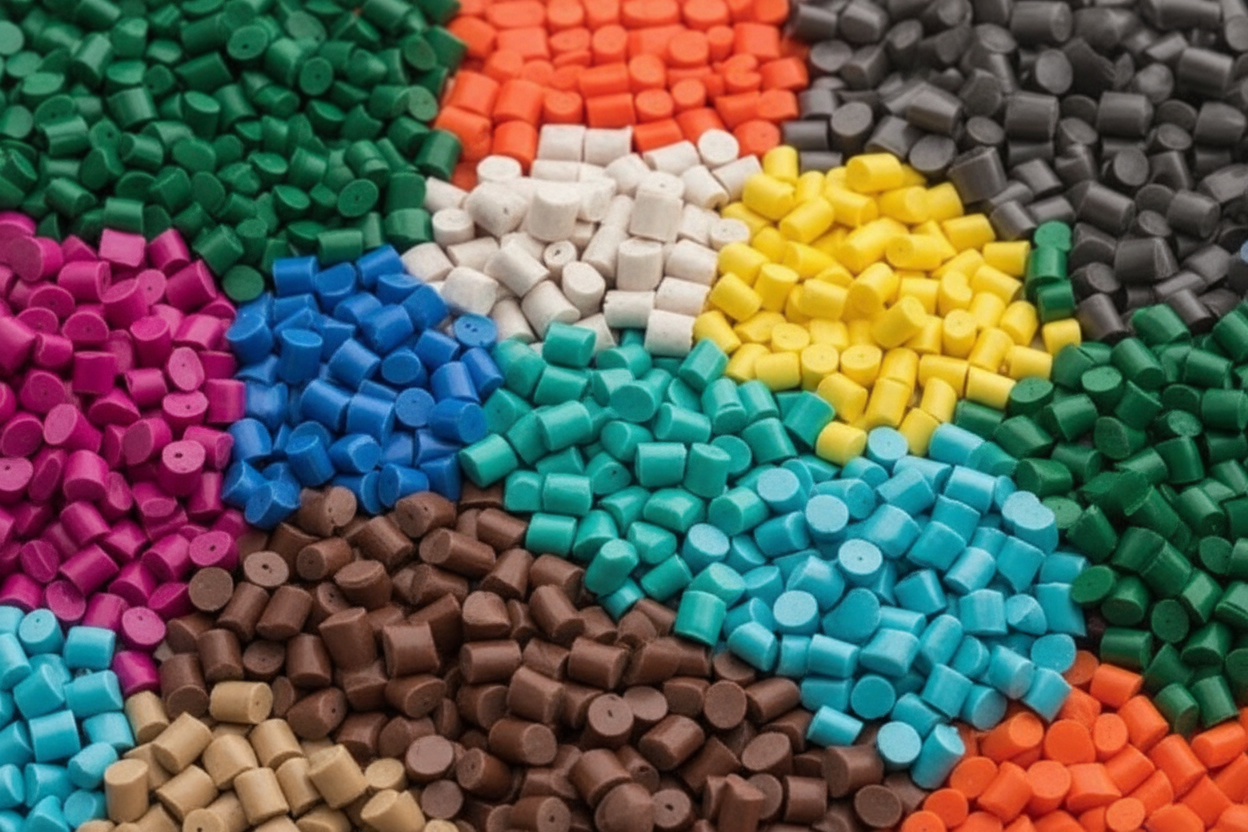
Once the polymer mixture is ready, it is transformed into usable forms like pellets or granules. In manufacturing, these pellets are heated until soft or molten. Then a forming process—such as injection molding, extrusion, or blow molding—is used to push or shape the molten material into a mold or into a continuous form. Finally, the piece is cooled, solidifying into its final shape.
Thus, the steps (in order) are:
- Polymerization and compounding (mixing additives)
- Pelletizing or granulation
- Heating to soften or melt
- Shaping (molding, extrusion, etc.)
- Cooling and solidification
Because thermoplastics can go through this thermal cycle more than once, scrap or leftover material can often be reprocessed.
Common Types of Thermoplastic
Here are some widely used types of thermoplastic, and what makes them useful:
Polyethylene (PE)
One of the most common plastics. It can vary from soft and flexible to rigid. You’ll find it in shopping bags, bottles, pipes, and packaging films.
Polypropylene (PP)
Lightweight, with good chemical resistance. It is used in containers, automotive parts, and many household goods.
Polyvinyl Chloride (PVC)
Can be rigid or flexible (depending on additives). It’s used in pipes, window frames, cables, flooring, and more.
Polystyrene (PS)
Often rigid and transparent or foamed (like Styrofoam). It is used in disposable cutlery, insulation, packaging, and model making.
Polyethylene Terephthalate (PET or PETE)
Clear and strong. Commonly used for drink bottles, food packaging, and synthetic fibers.
Acrylonitrile Butadiene Styrene (ABS)Tough and impact-resistant. Used for items like LEGO bricks, protective casings, and consumer electronics.
Nylon (Polyamide, PA)
Strong and wear-resistant. Used in gears, mechanical parts, clothing fibers, and ropes.
Polycarbonate (PC)
Transparent and very durable. Found in safety glasses, lenses, and electronic housings.
Polymethyl Methacrylate (PMMA or Acrylic)
Clear like glass but lighter and shatter-resistant. Used in signs, skylights, and display screens.
Polyoxymethylene (POM or Acetal)
Very stiff, low friction, and precise. Used in mechanical parts, bearings, and gears.
Each thermoplastic has its own balance of strength, flexibility, transparency, heat resistance, and cost. Engineers choose the one best suited to each job.
Key Properties That Make Thermoplastics Stand Out
Why do so many industries choose thermoplastics? Here are the main properties that give thermoplastics their strength in modern manufacturing.
Flexibility and Ductility
Many thermoplastics can bend without breaking. This flexibility is especially useful in packaging, films, or parts that must absorb impact.
Strength and Toughness
While thermoplastics aren’t as strong as metals in many cases, they can be strong enough for many functions. Engineering-grade thermoplastics (like nylon, polycarbonate, or POM) provide robust strength for demanding applications.
Chemical Resistance
Some thermoplastics resist acids, bases, oils, and other chemicals, making them suitable for plumbing, chemical containers, or protective casings.
Lightweight
Thermoplastics are lighter than metals of similar size, which helps in applications where reducing weight is important—such as in vehicles or portable devices.
Ease of Processing
Because they soften with heat, thermoplastics are easier to mold into complex shapes. They can be processed via injection molding, extrusion, blow molding, or even 3D printing.
Recyclability
One of the biggest advantages: thermoplastics can often be melted down and reused (though not always indefinitely). This gives them a sustainability edge (discussed further below).
Compared with Thermosets and Metals
- Thermosets can handle higher temperatures and retain shape under more extreme conditions, but they can’t be remelted or reshaped.
- Metals are stronger and more heat resistant, but they are heavier, harder to mold into complex shapes, and often more expensive to manufacture.
In many applications, thermoplastics strike a favorable balance of ease, performance, and cost.
However, thermoplastics also have limitations (which we will explore shortly).
Every-day Uses of Thermoplastic in Modern Life
Thermoplastics are so widespread that many of us use them constantly without thinking about it. Here’s a look at how they show up in daily life:
In the automotive industry, interior panels, dashboards, bumpers, and trim parts often use thermoplastics. Because they are lighter than metal and easier to shape, they help reduce vehicle weight and improve fuel efficiency.
In packaging, thermoplastics like PE, PP, and PET are used for bottles, wraps, containers, and films. Their flexibility and ease of sealing make them ideal for protecting food and goods.
Consumer goods—such as gadgets, appliances, toys, and furniture—are full of thermoplastic parts. For example, ABS and polycarbonate are common in consumer electronics housing; acrylic (PMMA) is used in screens and signage.
In electronics, thermoplastics serve as insulating materials, protective casings, connectors, and circuit board parts thanks to their electrical and thermal properties.
In healthcare, sterilizable thermoplastics are used for medical devices, syringes, implants, and equipment parts. The ability to mold precise shapes and reprocess materials is a major advantage.
Even in infrastructure, thermoplastic materials appear in things like window frames (PVC), piping, cable insulation, and road marking (hot-melt thermoplastic paints are used for road lines).
Because thermoplastics can meet many design requirements while being cost-effective, they have become a core component of many modern technologies.
The Role of Thermoplastics in Sustainable Manufacturing
In a world increasingly focused on sustainability, thermoplastics play an important role (though they are not a perfect solution).
First, recyclability is their biggest advantage. Because many thermoplastics can be melted and reshaped, waste materials and scrap can be reintroduced into production. This reduces raw material demand and lowers landfill waste.
Second, thermoplastics enable lightweight design. In sectors like transportation, using lighter parts means less fuel consumption or energy use—this contributes to lower emissions over a product’s life.
Third, production processes for thermoplastics can be efficient and produce less waste. Because they flow when molten, molds can be filled precisely, reducing excess material use.
Some newer developments push this further: bio-based thermoplastics (made from renewable sources like plants) and advanced blends or composites aim to combine performance with better ecological footprints. These innovations open the door to materials that break down more easily or use less fossil fuel–derived content.
However, sustainability is not guaranteed. The success depends on good recycling infrastructure, proper material design, and careful lifecycle planning.
Challenges and Limitations of Thermoplastics
While thermoplastics offer many benefits, they also come with a realistic set of challenges. A balanced view is important.
One major limitation is temperature sensitivity. Many thermoplastics begin to soften or deform at modest heat levels, which makes them unsuitable for high-temperature environments. Also, under long-term stress, thermoplastics can creep (gradually deform).
Another issue is environmental impact. If thermoplastics are not collected or recycled properly, they contribute to pollution. Some additives or plasticizers may leach chemicals over time. Also, degradation under UV light or exposure to environmental stress can make plastics brittle or discolored.
Performance trade-offs are also real. To get better strength or heat resistance, manufacturers often add fillers or reinforcements, which sometimes reduce recyclability or increase cost.
Recycling is also imperfect: every time you melt and reprocess thermoplastic, its properties may degrade slightly. Over multiple cycles, quality may decline.
Finally, some thermoplastics don’t resist certain solvents or chemicals, and not all are safe for food contact or medical use without proper formulation.
Because of these downsides, choosing the right thermoplastic and designing for reuse are essential parts of responsible engineering.
Innovations Shaping the Future of Thermoplastic Materials
Thermoplastic technology is far from static. Several exciting innovations are pushing the boundaries in performance and sustainability.
One direction is bio-based and biodegradable thermoplastics. These materials aim to reduce reliance on petroleum and improve end-of-life disposal. Researchers are developing plastics from plant sources or using engineered polymers that break down more cleanly.
Another trend is composite thermoplastics—combining polymer with reinforcing fibers (like carbon fiber or glass) in thermoplastic matrices to get hybrid strength, stiffness, and weight advantages.
Advanced processing, such as nanoscale additives or smart fillers (like graphene, nanoclays, or metal particles), helps enhance conductivity, mechanical strength, or thermal behavior without sacrificing weight.
In 3D printing, thermoplastic filaments continue to evolve, enabling more complex structures with embedded functionality. For instance, thermoplastic polyurethane blended with nanoparticles is being explored for photothermal or infrared-responsive designs in innovative applications.
Another exciting area is thin-ply thermoplastic composite shells, designed for aerospace or deployable structures. By carefully tuning microstructure and morphology, researchers are improving transverse strength by more than 150 % over older designs.
These innovations are helping thermoplastics become stronger, more sustainable, and more functional—bridging gaps between plastics, metals, and advanced materials.
Conclusion
Thermoplastic is more than just a plastic you can melt again—it is a powerful, flexible, and evolving class of materials that supports modern design, manufacturing, and sustainability goals. Its ability to soften under heat and harden on cooling gives it versatility, while its wide range of types lets engineers tailor properties for countless uses.
From everyday objects to high-tech devices, thermoplastics are reshaping how we build things. Although challenges remain—temperature limits, environmental impact, and performance trade-offs—ongoing advances in bio-based plastics, composites, and smart materials are pushing thermoplastic’s potential even further.
In the years ahead, thermoplastics are likely to remain a central player in sustainable, efficient design. They are helping us rethink what’s possible with materials—making products lighter, easier to recycle, and more creative in form. As industries continue to explore new blends, better processing, and greener raw sources, thermoplastic will keep redefining how we shape our world.
